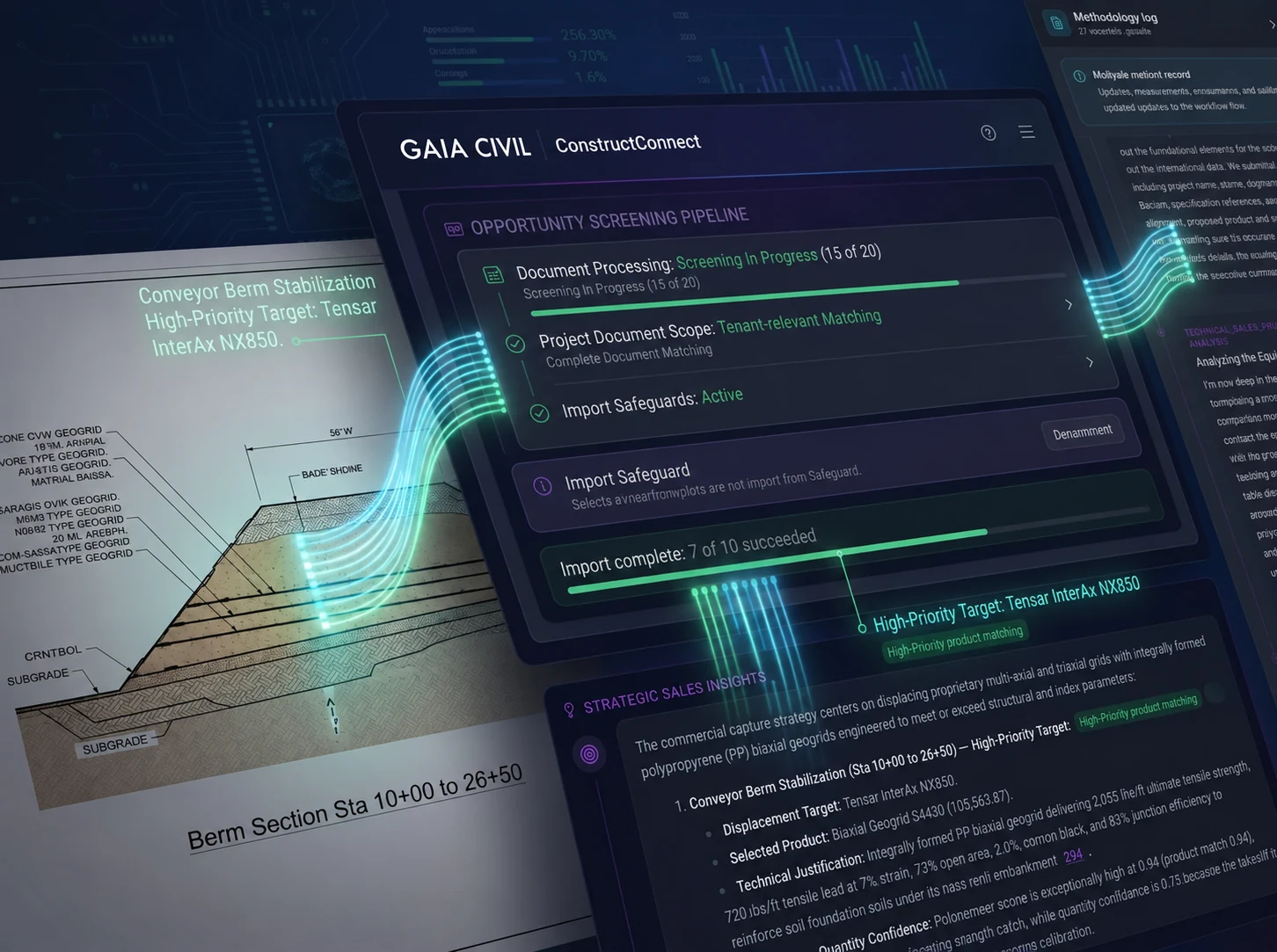
Opportunity enters the manual queue.
Every promising project starts another round of searching, opening, downloading, culling, organizing, and re-keying before technical review can begin.
Opportunity intelligence for construction products
GAIA Civil uses ORION to turn a 15+ hour manual qualification pass into a 3-minute prioritization result across 500+ page plan sets. Selected projects then move through multimodal analysis, CSI-to-drawing correlation, and source-backed Qualified Opportunity Reports for human commercial action.
100% Source-backed by design. Exact page citations, formula traces, and human review boundaries stay visible.

Why GAIA Civil
A lead is not a bid. Before a qualified person can price or pursue it, someone must search, open, sort, download, organize, read, and route the project record. That queue consumes the same people the business needs for judgment and selling.
Every promising project starts another round of searching, opening, downloading, culling, organizing, and re-keying before technical review can begin.
Estimators, technical salespeople, and engineers spend finite hours assembling the evidence they need instead of applying judgment to the opportunity.
When the team can process only so many packages before bid day, viable pursuits wait, substitution windows close, and potential revenue never reaches a go-or-no-go decision.
The automated engineer
For years, increasing bid capacity meant adding people to a manual queue. The queue was accepted as the way the work gets done because no automated system could carry it from lead discovery through relevant-document assembly and evidence-backed analysis.
ORION changes that staffing equation. It performs the repeatable pursuit-preparation work so skilled employees can spend their time on pricing, relationships, engineering judgment, and strategy.
More qualified pursuits create more chances to compete and win. Revenue still depends on fit, bid quality, pricing, market conditions, and win rate, but the manual queue no longer has to dictate how many opportunities reach a decision.
Beyond the low-hanging leads
Picture an endless pecan grove, its canopy heavy with untapped yield. Your team has one canvas sack and one bid clock, so it reaches for the obvious public listings and commoditized tenders every competitor can already see.
That is the physics of manual project discovery: valuable work exists higher in the canopy, but human hands cannot inspect every plan, specification, detail, and addendum before the window closes.
ORION REDEFINES THE PHYSICS OF THE HARVEST.It gives a specialist the leverage of a much larger review operation: screening dense project sets, directing attention to the strongest opportunity signals, and carrying source context into the next qualified action.
Turn approved application, product, competitor, and commercial context into repeatable discovery logic, then rank likely-fit projects before expert time is committed.
Connect supported plans, specifications, addenda, schedules, and details as one project record so high-value alternate paths do not stay hidden between documents.
When the evidence supports it, carry first-pass quantities, comparison context, exact locators, open questions, and a recommended owner into a review-ready package.
ORION accelerates discovery and qualification; final estimating, suitability, equivalency, engineering, and bid decisions remain with qualified people.
ORION inside GAIA Civil
Native document vision, long-context synthesis, evidence retrieval, structured outputs, computation, specialist orchestration, and governed MCP tools operate together against one project record. The result is more than an answer: it is qualified work your team can inspect and move.
The wider ecosystem
Status matters. The groups below separate services in GAIA Civil’s current architecture from priority connector targets that are scoped with each tenant. Listing a target does not imply a live connector, release commitment, or vendor partnership.
Route qualified opportunities, evidence, owners, and next actions into the systems commercial teams already use.
Meet teams in the files, analysis, collaboration, and cloud environments where bid work continues.
Procore workflows are wired in GAIA Civil. CAD support ranges from standalone DXF generation to optional licensed AutoCAD automation on supported Windows systems.
Move approved GAIA Civil records through governed machine-to-machine and document handoffs without hiding the human approval boundary.
The managed reasoning, multimodal, retrieval, data, storage, caching, research, and observability capabilities that support ORION workflows inside GAIA Civil.
Document retrieval depends on the plans, specifications, addenda, and other source files available and authorized for each project. Connector scope, data direction, field mapping, and approval gates are defined during implementation.
Inside the workflow
Explore four connected stages of the GAIA Civil experience. ORION narrows the question at each stage while preserving a path back to the source.
Concept and staged product views use illustrative demo data. Names, metrics, product references, and UI statements visible inside the images are not customer results, final estimates, product equivalency, engineering conclusions, or endorsements.
A connected platform
GAIA Civil combines ORION-powered screening and analysis with evidence inspection and governed commercial handoff in one construction-native review environment.
Screen candidate project PDFs against approved product parameters to instantly rank pursue, review, and reject decisions before committing engineering hours.
Automatically cross-reference CSI MasterFormat divisions, drawing detail callouts, geotechnical notes, and addenda modifications across the entire set.
Keep exact document, page, sheet, section, and revision locators beside every finding so technical reviewers can verify the physical basis in seconds.
Package product fit, requirements, first-pass quantities with formula traces, open questions, and recommended next actions in one actionable report.
Expose step-by-step reasoning logs, validation updates, review notes, and immutable report versions instead of opaque black-box answers.
Build and save structured discovery strategies around applications, products, competitor displacements, and commercial flexibility language.
Use Automatic Mode for connected, project-wide reasoning and High-Yield Screening when the goal is to rapidly surface material savings, performance improvements, and value-engineering paths for qualified review.

Carry the approved source set, tenant context, citations, calculations, and engineering questions into a deeper research lane without losing the project boundary or the route back to evidence.

The output
GAIA Civil packages ORION’s work around the questions a commercial and technical reviewer actually needs, with evidence instead of an unexplained answer.
Document · page · sheet · section · revision
What the evidence states or supports
Approved product and application knowledge
Conflict · assumption · missing information
Reviewer · question · recommended follow-up
Security and governance
GAIA Civil’s production posture combines tenant-scoped access, isolated data stores, encrypted transport and storage, zero-training commitments, network-disabled managed sandboxes, human approval gates, and documented recovery objectives. The security section makes both the controls and buyer review path explicit.
Review signed-in flows, permission checks, complete data paths, deployment controls, and contractual boundaries together.
Product fit
GAIA Civil fits a specific kind of commercial work: valuable opportunities hidden inside complex construction documents, with qualified people responsible for the final decision.
Frequently asked questions
GAIA Civil is deliberately specific about what ORION supports, what still requires judgment, and what needs to be verified for an implementation.
GAIA Civil gives geosynthetics and construction-product teams a governed workspace where ORION screens project document sets, connects relevant evidence across those documents, and organizes the result into a source-backed Qualified Opportunity Report for human commercial review.
A scoped review can include plans, specifications, addenda, schedules, tables, details, and available quantity sources. The useful source set is agreed for each implementation, and every file still depends on legibility, context, and review boundaries.
The extension runs approved saved strategies from GAIA Civil Query Architect inside the user’s signed-in ConstructConnect session, returns projects for human selection, and retrieves the available, authorized plan, specification, and addendum material that matches the tenant’s onboarding-aligned document policy. It omits unrelated material before handing the selected project record into ORION screening. It does not automate login, bypass access controls, or make the pursuit decision for the user.
No. Search may help locate text, but ORION is designed to connect evidence across a project record, apply approved product and application context, preserve conflicts or missing information, and package the finding for review inside GAIA Civil.
No. ORION supports first-pass screening, analysis, and commercial qualification inside GAIA Civil. Final estimating, engineering, technical suitability, compliance, equivalency, and commercial decisions remain with qualified people.
ORION can support first-pass qualification quantities when a suitable source exists. Units, locators, assumptions, and calculation context remain visible in GAIA Civil; when support is missing, the report preserves UNKNOWN instead of inventing a number.
The workflow is designed to keep assumptions, contradictions, incomplete evidence, and unresolved decisions visible. Confidence helps prioritize review, but it is not presented as proof or a substitute for the cited source.
GAIA Civil combines authenticated, role-aware access with tenant-scoped relational records, tenant-dedicated vector collections, namespaced object storage, encryption in transit and at rest, and isolated execution for managed deep-review tasks. Customer data is contractually excluded from foundation-model training. The security section explains the full control model and buyer diligence path.
Start with a bounded commercial question, representative approved documents, the product and application context, the responsible reviewers, and clear acceptance criteria. Pegasus can then define a controlled walkthrough or evaluation path.
See GAIA Civil in context
We’ll map the lead sources, saved searches, tenant context, documents, reviewers, and downstream systems GAIA Civil and ORION need to turn more opportunities into governed, review-ready work.